

🔧 Technical Overview
Surge is a Bitcoin-native credit market. Borrowers lock real BTC under programmable Taproot scripts, lenders supply stablecoins to a multi-market credit pool, rates, liquidation, and settlement are coordinated by audited code rather than custodians. The architecture is built so a borrower can always recover their BTC on Bitcoin alone, and so an LP's claim is always backed by a verifiable on-chain position.
What Surge Is Made Of
The system is built from four cooperating components. Each owns a distinct layer of the protocol, everything else in the stack supports one of these.
| Component | Where it lives | What it owns |
|---|---|---|
| Taproot Vaults | Bitcoin | The collateral. Programmable spend conditions (Repayment / Liquidation / Exit) committed at vault creation. |
| Threshold Signer Network (TSN) | Off-chain decentralized signer organisations | Threshold Schnorr signatures on Bitcoin spends. No signer holds a complete key, no quorum can move BTC outside policy. |
| Smart Contracts | EVM (Base, Ethereum) | The debt ledger, share-based liquidity pool, interest-rate model, and Dutch-auction liquidation. |
| Relayer & Workers | Off-chain service | The coordinator. Watches Bitcoin, drives the contracts, proposes spends to the TSN, and finalises CCTP transfers. Holds no custody. |
A stablecoin liquidity layer routes USDC across chains so the pool stays canonical regardless of where supply originated. A per-signer oracle path feeds BTC/USD into health calculations.
How They Fit Together
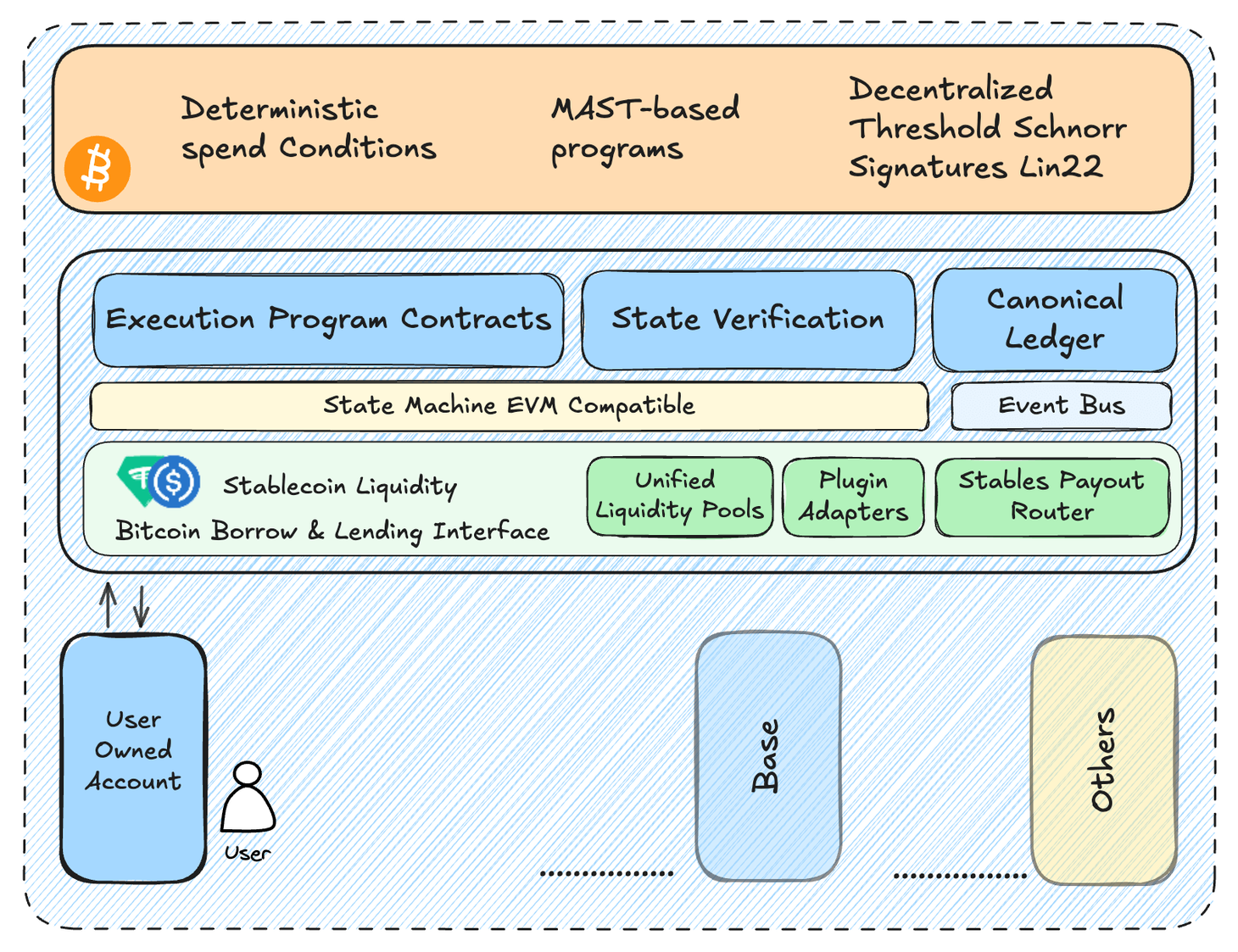
Architecture Overview
- Borrower deposits BTC to a Taproot output whose scriptTree commits the three spend leaves and uses a NUMS internal key derived from
SHA256("SURGE-NUMS")(output:6a1bac977b8af761b330d1473dba1e5cfc75b3256a1ae900b78a369e175423f2), with key-path spend disabled. The deposit address is derived deterministically from the borrower's wallet plus an aggregateloanPubkeyproduced by the TSN. - Relayer observes the deposit at the configured confirmation depth and calls
VaultManager.submitLoan(...)on the EVM side. APositionIDis minted and the stablecoin liability is recorded on the canonical ledger. - Borrower receives USDC - drawn from
LiquidityPoolon Base today, with Ethereum routing supported through CCTP v2. Additional chains are planned. - Position lives. The relayer streams oracle price updates into the position's health calculation; workers monitor the collateral ratio against
MinCRand the liquidation threshold. - Closure happens on one of three Bitcoin spend paths:
- Repayment (cooperative) - borrower repays USDC, the TSN co-signs a release of BTC to the borrower's withdrawal address.
- Liquidation (TSN, authorised) - collateral ratio breaches the liquidation threshold, or the credit line is past term and unpaid, the TSN signs a sweep to a Dutch auction, proceeds retire the originating market's debt.
- Unilateral Exit (borrower alone, after CSV) - if everything else fails, the borrower spends the Exit leaf after a relative timelock and walks away with their BTC.
Why Each Layer Exists
- Taproot Vaults keep custody on Bitcoin. Collateral stays under script control; no bridge, wrapped BTC, or platform custody assumptions.
- The TSN provides threshold signing without multisig footprint. On-chain spends look like standard Schnorr signatures while signer policy is enforced off-chain by independent validators.
- EVM contracts run the credit engine. Debt accounting, market logic, rates, and liquidation are handled where stateful finance is efficient, while BTC custody remains on Bitcoin.
- The relayer handles operations, not authority. It automates monitoring, submissions, and cross-chain settlement, but cannot move BTC or mint unbacked USDC.
The Trust Boundary
Bitcoin script enforces custody. Threshold cryptography enforces "no single signer compromise loses funds." EVM contracts enforce accounting. The relayer is convenience infrastructure. A compromised relayer can delay things, it cannot move BTC, cannot mint debt, and cannot cause LPs to lose principal.