

🔐 Self-Custody User Wallet
The Surge app holds the borrower's wallet and is designed with self-custody at its core. Every wallet instance ensures that private keys are created, stored, and used exclusively under the authenticated user's control. The user - not Surge - has authority over signing actions, key export, stablecoin distribution, and the return address used by every spend path.
The signing environment runs as a sealed runtime within hardware-isolated infrastructure. Once instantiated, its memory and code are cryptographically measured and isolated so that operators, administrators, and the host kernel cannot read, export, or modify a user's private key.
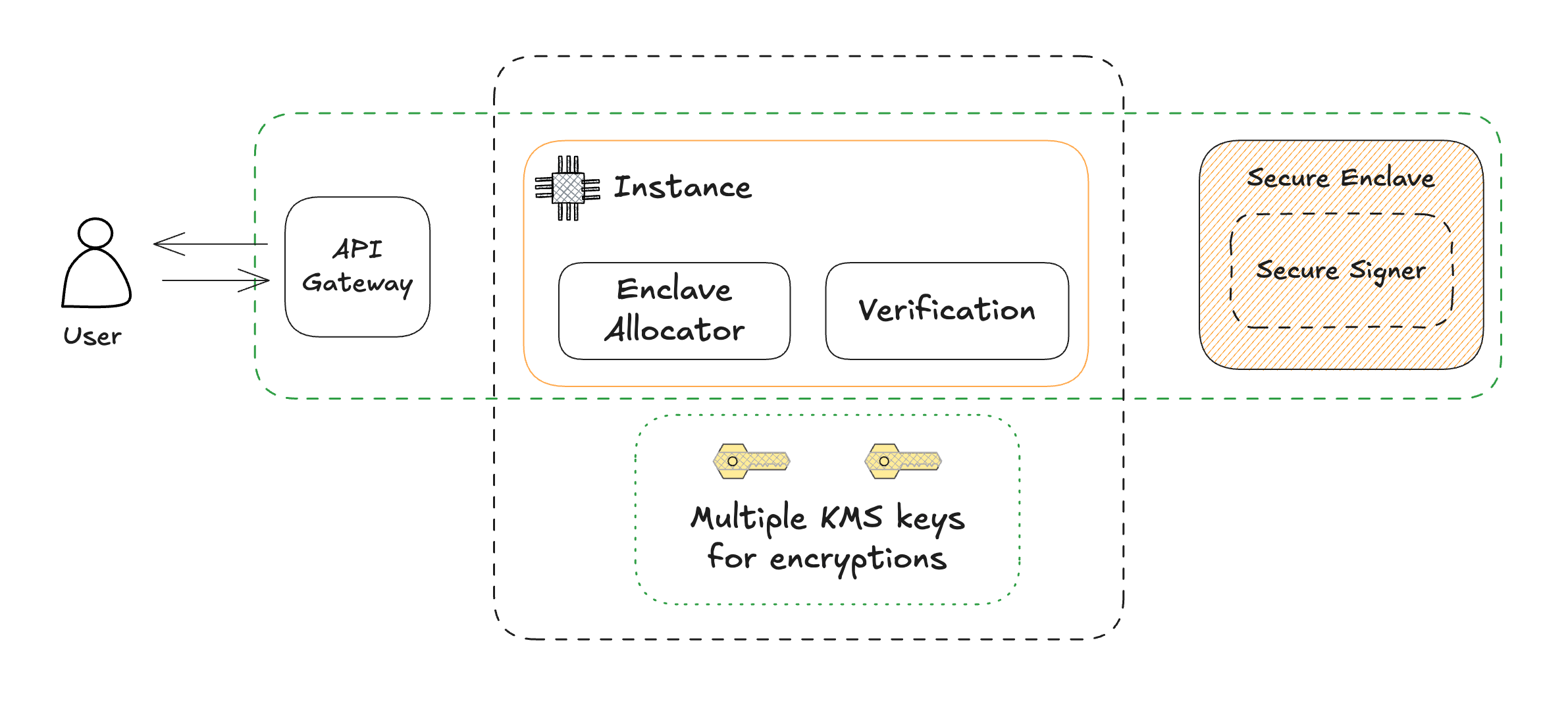
Secure Enclave Architecture
Authentication & Key Lifecycle
1. Email login & session initialization
- The user authenticates with email + OTP.
- A short-lived JWT session token is issued on successful verification.
- The token authorizes enclave operations during its validity window; expiry forces re-authentication.
2. Deterministic key generation
- On first login the runtime queries the enclave for an existing keypair bound to the user.
- If none exists, the enclave generates a new asymmetric keypair internally.
- The public key is returned to the application layer and mapped as
{ userID, email, publicKey }. - The private key stays sealed inside isolated memory and is never serialized outside the trust boundary.
2b. Optional wallet import (mnemonic)
- If mnemonic import is enabled for a deployment, users can import an existing wallet during setup.
- The mnemonic is used only to derive key material inside the sealed runtime.
- After import, only sealed key state is retained; the mnemonic is not kept as persistent plaintext.
- The user confirms the derived public key before activating the imported wallet.
3. Transaction signing flow
- The client submits a transaction payload alongside the active JWT.
- The backend validates the session and forwards
{ userID, txData, signatureRequestID }into the enclave. - The enclave verifies request authenticity and authorization before signing.
- Signing happens entirely inside the sealed environment; only the resulting signature leaves the boundary.
4. Controlled key export
- A user can export their private key for self-managed custody.
- Export re-prompts for OTP and encrypts the key with a user-defined passphrase.
- The encrypted blob is portable: the user can store it offline, in another wallet, or in third-party custody.
Self-Custody Properties
| Property | Enforcement |
|---|---|
| User ownership | Cryptographic operations originate from keys generated under the user's control. |
| Key isolation | Keys are sealed inside protected compute environments, isolated from application and infrastructure layers. |
| Portability | Encrypted key export allows migration and independent storage. |
| No silent recovery | Surge has no path to reconstruct a private key without the user's passphrase or active session. |
Hardware-Backed Isolation
Wallet key management runs inside hardware-backed Trusted Execution Environments (TEEs). Each instance produces a cryptographic attestation report at initialization that:
- Verifies the environment is running on genuine, unmodified hardware.
- Verifies the loaded code matches the approved wallet binary.
- Revokes trust automatically if either the code or the environment changes - any tamper alters the attestation fingerprint.
This produces verifiable proof that the wallet enclave is authentic, unmodified, and operating in a known-good state.
Versioning & Update Lifecycle
Enclave binaries are immutable at runtime. Updates and bug fixes go through a versioned redeploy:
- Build a new enclave image with the updated wallet logic.
- Deploy and verify its new attestation measurement.
- Migrate users to the new measurement only after the fingerprint is publicly recorded.
This guarantees that every running wallet instance corresponds to a code version that has been measured, attested, and observable from the outside.
Roadmap
The Confidential VM platform underpinning the wallet enclave continues to evolve. The current roadmap includes broader hardware coverage (additional CVM platforms beyond the current deployment), public attestation transparency for the wallet's measurement history, and tighter integration between the wallet's attestation and the Threshold Signer Network's signing-policy validators so that authorisations from this wallet can be recognised by the TSN as originating from a measured, sealed environment.
The intent stays the same regardless of platform: the user holds the key, the runtime never reveals it, and any change to the runtime is publicly verifiable.